
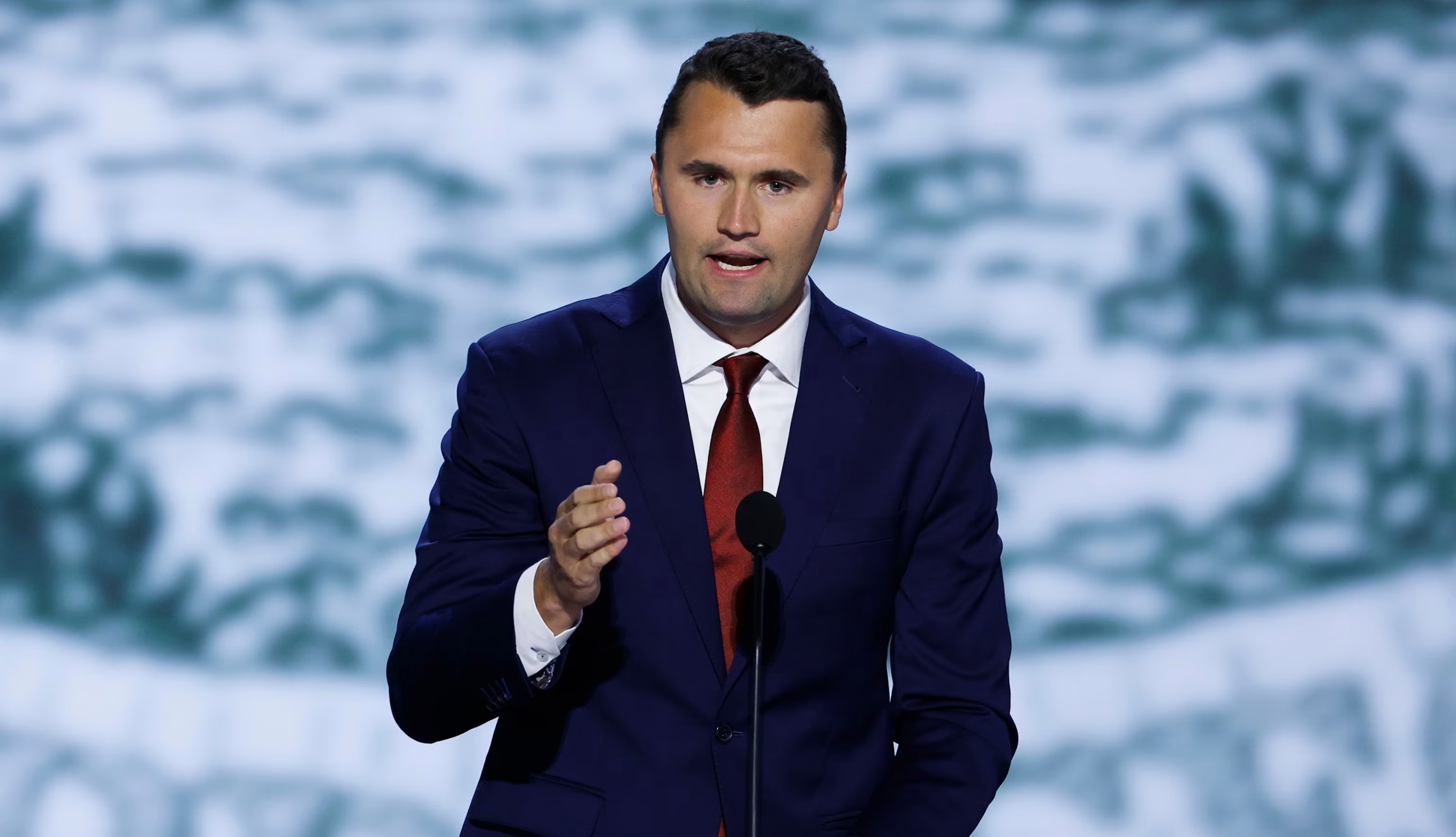
Charlie Kirk speaks at the 2024 Republican National Convention. Kirk was killed while speaking at the Utah Valley University in September 2025. Image Courtesy of Pixbay.com
By Nelson Kerr-Ritchie and Austin Wymore
Senior Anthony Bullock was on his phone in English IV when he saw the video of Charlie Kirk’s assassination.
“All of the sudden, I was on Instagram, and this guy was just bleeding out everywhere,” Bullock said.
Kirk, a conservative political commentator, was shot last September during a speaking event at Utah Valley University. The incident occurred around 12:30PM, while Riverside classes were in session. Graphic videos of the incident spread rapidly online.
“It was really bad,” Bullock said. “Hard to forget.”
Despite the political implications, students seemed mostly concerned with the graphics of the killing rather than the violent climate it brought to politics. English teacher Frank Hayes described a more muted response from his students:
“They were showing me the videos of him getting shot, and there were no, ‘oh my God, this is so sad,’ or, ‘Oh my God, I can’t believe somebody did that,’”Hayes said. “It was more like, ‘Mmm.’”
A constant barrage of violence
Political violence in the US made headlines again and again in 2025. From the November 26th shooting in Washington DC that killed a member of West Virginia’s National Guard, to the assassination of Kirk and the murder of two legislators in Minnesota on June 14th, to the North Carolinian who attempted to enter Mar-a-Lago on the 22nd, the topic has driven the news cycle and conversations for Americans on all ends of the political aisle.
Throughout history, there have been attempts on the lives of 17 out of 47 presidents, four of which were successful. The difference now is social media, according to criminal justice expert Dr. Michael Pattario.
“Nearly every single day, we, as a global society, are exposed to what seems like to a constant barrage of violence, negativity, intolerance, and hatred in one form or another on the major news networks, and especially on social media,” Pittaro said in a 2019 interview with Psychology Today.
Even though less than 1% of all hate crimes have been classed as political violence, over 400 reported incidents of political violence have been recorded between 2020 and 2025, including two assassination attempts on now-President Donald Trump. There were 61 politically motivated killings from 2022 to 2024, but 2025 alone saw 150 politically motivated attacks within its first six months.

Reported incidents of political violence since 2015
Souce: Dr. Michael Jensen / CNN
Studies have also found that concern with political violence tends to align with political affiliation. A 2025 study conducted by the Pew Research Center found that 85% of Americans believe political violence is increasing. According to an AP poll, “about 6 in 10 Republicans are ‘extremely’ or ‘very’ concerned about political violence directed at conservative political figures or organizations, while only 27% are highly concerned about political violence directed at liberal political figures or organizations.”
For Democrats, about 6 in 10 are “extremely” or “very” concerned about political violence directed at liberal political figures and organizations, while 38% are highly concerned about political violence directed at conservatives.
Per Harvard polling, nearly 40% of young Americans believe that political violence is acceptable in certain circumstances. An August 2024 survey by Citizen Data found that only 44% of Gen Z and 67% of millennials believed that violence against elected officials was never acceptable. Approval on crimes like violent felonies, however, remain at less than 5% at both ends of the political spectrum. Data indicates that the current level of political violence the USA is nearing, and sometimes exceeding, those of the late 1960s and early 1970s, when mass protests and riots over social issues, and the assassination of figures like Robert Kennedy and Dr. Martin Luther King Jr. occurred.
Concern for political violence directed at opposite political groups

A lack of empathy
Some teachers at Riverside blame social media for the normalization in political violence among their students.
“Political violence has definitely increased, and we understand it’s a direct result of the internet, specifically algorithms,” said social studies teacher Robert Paton.“In the aftermath of the Kirk murder it’s pretty obvious that nobodies all across the country were able to tweet insensitive things and then get amplified in a way that you used to only be able to do with access to mass media.”
“There just seems to be an amplification that’s different than it ever has been,” said English teacher Matthew Smith. “That sensational content generates views, whether that’s newspapers or radio programming or social media or anything.”
Some Riverside students expressed concern about the precedent that political violence sets. Senior Ari Volo expressed that, despite their initial reactions of shock, was deeply concerned about the examples being set.
“I did not appreciate [it],” Volo said. “It sets a precedent that it’s okay to commit violence against people that are not even directly involved.”
Polling seems to support the idea of a correlation between favorable views of political violence and heavier use of social media. A Gallup project published in December found that younger people with a heavier use of social media are more likely than any other group to justify political violence. Nearly 60% of those who said that political violence is “sometimes OK” reported using social media for more than an hour a day.
“I think that, especially in an industry that’s measured in metrics—how many views did you get, how many subscribers do you have, that kind of thing—even if it’s not hyperviolent and political, the more salacious and outrageous your content, the more likely people are to tune in,” said Smith.
While we were writing this story, two more major incidents of political violence occurred. In two separate incidents, Renee N. Good and Alexi Pretti were shot by ICE agents in an operation in Minneapolis. Similar to the assasination of Charlie Kirk, many students we spoke to had seen this incident on their social media as well.
Freshman Nora Olen remarked that when she saw the videos of the shootings on her social media, she “thought that was really awful, and it made me really upset.”
But beyond the media and algorithms, some students believe the real issue is a lack of human empathy when it comes to such violence.
“It doesn’t matter if you’re a conservative or liberal,” said senior Jeremiah Savage. “If somebody dies, it’s your job to stand out and speak up about that if you have the power to do so. To ignore murder because of your political view on either side is wrong.”


